
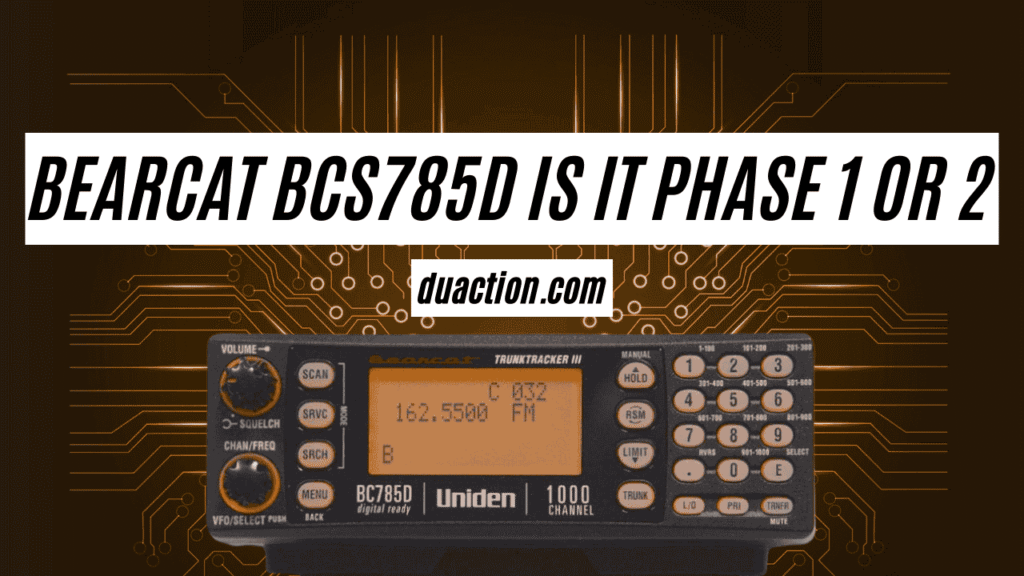
Many people who wondering “bearcat bcs785d is it phase 1 or 2” is received the answer. A lot of people who are interested in radio scanning ask the same. To answer in the simplest way: Bearcat BCS785D handles P25 Phase 1 (with the right digital module) but does not handle P25 Phase 2 (TDMA) decoding. However, to understand its usefulness today, and if you should upgrade or not, let’s delve deeper.
The Basics: P25, Phase 1 vs Phase 2, and Understanding Analog to Digital Conversion
Radio scanning first came out as entirely analog. A voice is modulated continuously on a certain frequency, and your radio receives the modulated voice, demodulates it, and you hear the voice or some tones. While this works for lots of uses, the increased demand (as in more agencies and channels) and limitations of the spectrum made the digital systems more popular.
To the communications system, radio and voice channel multiplexing is digital. Voice (data) is converted to digital, compressed, and transmitted over the radio channel. The digital systems use spectrum more efficiently, provide clearer signals, and a lot other advanced capabilities (like error detection).
What is P25?
P25 (Project 25, also written APCO-25) is a suite of standards for inter-agency public safety and government radio communications systems for many countries. It specifies the structure of digital radio communications in a way that allows, in theory, equipment from different vendors to interoperate. If you hear “P25 digital system,” it usually refers to a trunked or conventional digital public safety radio network.
Phase 1 vs Phase 2: What’s the difference?
- P25 Phase 1 is implemented using FDMA (Frequency Division Multiple Access). It is the simplest of the systems since one voice signal is transmitted through one frequency channel and does not overlap with any other signal.
- P25 Phase 2 is implemented using TDMA (Time Division Multiple Access) in which the same channel is used for two separate voice streams one after the other. This effectively doubles the system’s capacity.
- The time-slotting of TDMA means that the scanner must understand the time slots to decode the two streams.
- In practical terms: If your scanner can only decode Phase 1 (FDMA) and it is faced with a Phase 2 broadcast, you will hear nothing, garbled audio, or fragments.
- Due to its efficiency, a lot of contemporary public safety systems are moving or have already moved to Phase 2. So, in 2025, it makes sense to ask whether your scanner supports Phase 2.
What Is the Bearcat BCS785D?
When Bearcat BCS785D (or BC785D / BCS785D) was manufactured by Uniden in the 2000s, the digital systems were just emerging, while uncountable numbers of analog systems were still in operation. BCS785D sought to provide a digital capable scanner that handled analog trunking systems and offered a limited path to digital systems (for certain modes) through add-on modules.
As mentioned on RadioReference Wiki, BC785D is tagged as “Digital Capable” because of its ability to utilize APCO-25 Digital Audio, pending the incorporation of the optional BCi25D digital card.
RadioReference Wiki
This also includes support for Motorola Type I / II trunking, EDACS, analog systems and, of course, some P25 digital voice with the additional card.
Key specs & features
As provided in the BC785D owner’s manual directly:
- Capacity: up to 1,000 channels, 10 banks
- Frequency coverage: VHF, UHF, 800 MHz and above
- Built-in TrunkTracker III (for trunked systems)
- Includes APCO P25 optional digital card slot
- Includes trunked analog and digital voice support, as well as conventional analog scanning
- Includes PC control features for programming the scanner, memory management, scan lists and channels prioritizing, etc.
- RadioReference Wiki states: “is compatible with . . . Analog and APCO-25 Common Air Interface (with the optional BCi25 card installed).”
The digital card: indispensable for decoding P25
The BC785D will work as an analog/trunked analog scanner without the digital module. To decode P25 Phase 1 digital signals, the BCi25D digital card (or whichever version Uniden supplied) is needed.
Not having the card does not mean the BC785D will automatically fail to support all digital protocols. The design primarily focuses on P25 and legacy systems, so digital systems such as DMR, NXDN, and others will not be supported as extensively.
The BCS785D and Phase 2
P25 Phase 2 (TDMA) expects the more complex requirements of time-slot synchronization, advanced digital signal processing, and the hardware/firmware functions to split and recombine the two time streams. Given the technology of the era, the BC785D was designed before Phase 2 was widely available, and thus its core systems (DSP, firmware, FPGA, etc.) were never designed to support TDMA.
- It does not have the processing power or the dedicated logic to understand the TDMA time slots.
- It is difficult to modify the firmware to support Phase 2.
- Even if there were an attempt at a “hack” or custom firmware, the timing precision needed is likely absent from the hardware.
- This is affirmed by several competitor articles: “Only P25 Phase 1 is supported by the Bearcat BCS785D. P25 Phase 2 (TDMA) is unsupported.”
Audio that is partial or garbled, not reliable decoding
In many practical tests, when a Phase 2 signal is present, a scanner without TDMA support may:
- Produce no audio
- Produce broken, lurching, or distorted audio
- Drop in and out
- Fail to follow talkgroups correctly
- These symptoms indicate that the scanner is receiving a digital signal, but it is unable to parse it correctly. The timing is confused.
- So while you might “hear something,” it’s not reliable or usable for monitoring.
Why this limitation often surprises users
It is common for users to see specifications indicating “digital capable,” “P25 compatible,” or “digital audio ready,” and assume full modern compatibility. This type of ambiguous marketing certainly does not help. As one article describes, “Advertising wording like digital capable or P25 compatible can be read as blanket support… but it only supports Phase 1.”
Moreover, some users interpreting forum posts incorrectly some hear a brief audio in Phase 2 zones and conclude their unit works. Most of the time what users hear is radio noise, or what technicians refer to as squelch artifacts, or incomplete audio decoding.
Also read more Literoticatags
Step-by-Step: How to Test If Your BCS785D Works in Your Area
Here’s a practical, hands-on approach to seeing whether your BC785D can decode the local digital systems.
Step 1: Confirm your hardware is properly set up.
- Make sure your scanner has the optional digital card (e.g. BCi25D or equivalent) installed and functioning.
- If Uniden has issued any updates for your model, check to see that the firmware is up to date.
- Your antenna and signal path should reflect good signal quality (low noise, strong signal level).
- If it lacks the digital card, it will only decode analog and trunked analog.
Step 2: Examine which digital systems are employed in your area.
- Visit RadioReference.com and see what your city / county’s public safety communication systems are, and what digital standards are in place (P25 Phase 1 vs Phase 2).
- Participate in local scanner and amateur radio (ham) communities. Ask them what systems have been improved.
- Surveying your local spectrum with software tools like SDRTrunk or DSD+ and an SDR (software defined radio) can show you what modes are available.
- If your area is fully Phase 2, your BC785D will likely not decode everything you want.
Step 3: Input the trunked system frequencies into your scanner.
- Begin with the control channel(s) frequencies, then input the voice channels frequencies.
- If you have any, enter the corresponding talkgroup IDs.
- As required, configure the bank or mode to digital / trunking.
- For the rest, check the programming guide in the BC785D manual.
Step 4: Observe
- If the system is Phase 1: you should hear clear, decoded audio on talkgroups.
- If the system is Phase 2: you will most likely encounter silence, garbled, or broken audio.
- To see the difference, try to use a Phase 2 scanner on the same system.
- If the BC785D does not keep up in a known Phase 2 area, that confirms your scanner’s limitations.
Step 5: Compare
- Document your observations (channel, time, signal strength, what you heard)
- Cross reference to community reports or what a newer scanner hears.
- You will know your BC785D’s performance in your actual environment.
- You can now confirm “Is my BC785D working for Phase 2?” for your specific zone.
Where the BC785D Still Shines — And Where It Fails
If your local agencies still run analog systems or P25 Phase 1, the BC785D continues to be useful:
- Monitoring fire, EMS, police, utility, and government analog channels
- Trunked systems still using Phase 1
- Backup scanner, secondary device, or educational tool
- Listening to aviation, marine, weather, ham, and other analog bands
- In those cases, it remains a capable tool—even in 2025.
Trouble zones: full Phase 2 or transitions
In urban areas or regions where agencies have upgraded to Phase 2, the BC785D becomes severely limited:
- You may miss many conversations entirely
- Public safety communications may be inaccessible
- Some mixed systems (hybrid Phase 1 + Phase 2) may partially work, but not reliably
- As agencies complete migration to Phase 2, the usefulness diminishes further
- If your area is in transition, you may hear some early channels, but not all. Over time, gaps grow.
Anecdote: “The scanner that heard 90%—until it didn’t”
Many in the scanning community have experienced the following anecdote:
- John is a scanner hobbyist who lives close to a mid-sized city. He had a BC785D and it worked wonderfully—he could listen in on police, fire, EMS, and even utility services. He thought he was “covered”. One day the local fire department announced they were upgrading to Phase
- John shrugged—he thought his scanner would still pick up something. But when the switchover happened, his BC785D recorded nothing on those channels—no voices , no noise, just silence. The scanner that had reliably delivered 90 % of what he needed was suddenly blind to a major slice of local communications. He bought a newer scanner and kept the BC785D as a backup for aviation and analog stuff.
- That’s a cautionary tale: until you confirm your local moves, a scanner you trust might suddenly become obsolete in your area.
- Upgrading Options: Considerations for Your Next Purchase (and Using BC785D Alongside)
When upgrading your scanner, consider ones that:
- Confidently work with P25 Phase 2 (TDMA) and also Phase 1 for backward compatibility,
- Offer many protocols including DMR, NXDN, etc. if required
- Have positive firmware updates with community backing
- Have software programming, GPS scanning, and broad coverage
- Include advanced features
Uniden SDS100, SDS200, and BCD436HP are recommended upgraded models. They are Phase 1 and Phase 2 compliant and are considered “future-proof.” Many modern reviews and guides reference these models as ideal upgrades for many enthusiasts.
Your BC785D is still valuable:
- Use dedicated analog scanning if the newer model skips analog channels
- Use for airband, weather, ham, and additional analog frequencies
- Serve as a scanner backup if your primary fails, or for traffic separation
- Allow experimentation with programming and settings
- Monitor under analog or Phase 1 persistent regions
- Dual scanner workflow, as many enthusiasts do, routed according to their traffic.
Recommendations, Pitfalls & Best Practices
- Before assuming there’s full coverage, always check local digital systems (RadioReference, local forums).
- Have strong antennas and receive paths—digital signals can be demanding.
- Keep firmware & programming software current.
- During testing, if possible, use a known Phase 2 capable scanner for comparison.
- As parts for the BC785D become more difficult to source, keep your the scanner in working order.
Common pitfalls to avoid
Underestimating “digital capable” in terms of coverage and overlooking full modern compatibility.
Acquiring a BC785D and assuming it will provide Phase 2 coverage.
Ignoring planned transitions—agencies may upgrade over time, leading to potential gaps when signal reception is tuned, the antenna, or systems details are ignored.
Also, be cautious of sellers promoting a BC785D as “now supports Phase 2.” This is untrue and misleading.
FAQs
Does the BC785D support P25 Phase 1 or Phase 2?
It supports P25 Phase 1 (with the optional digital module) but does not support Phase 2 (TDMA) decoding.
Can I upgrade my BC785D to Phase 2 via firmware or a card?
No—there is no official firmware or external card upgrade to add Phase 2, and the internal hardware does not support TDMA.
If “digital capable” scanners cannot do everything, why did manufacturers release them?
In the past, “digital capable” scanners meant capable of handling older digital modes (like P25 Phase 1) and/or having modular upgrades. It did not mean that the scanner would handle more advanced upgrades, like Phase 2.
What happens if my area has a mix of Phase 1 and Phase 2 systems?
You may partially decode some channels (those that are Phase 1) but there is a good chance that the Phase 2 channels will be garbled or you will completely miss the audio.
Should I get a new scanner now?
If your area is at least planning to use Phase 2, then the answer is yes, it is a good time to. If your area is still Phase 1 or analog, then your BC785D is still suitable for use for the time being.
Summary & Final Thoughts
To address the concluding question: for the Bearcat BCS785D, is it Phase 1 or Phase 2? The answer is, it is Phase 1, and it does not do Phase 2.
The reason for this is due to a design era, architecture, and lack of TDMA support. With the shift to Phase 2 in a lot of jurisdictions, this design limitation becomes more significant.
Even so, BC785D still holds some value. It remains competent scanner for analog and Phase 1 zones, possible range for being a backup scanner for older BC785D is for analog or niche tasks to be used alongside newer BC785D for teaching, tinkering, or learning purposes.
Before acquiring any gear, always check within your area: what digital systems are functional, operate your BC785D to crosscheck with newer equipment for a future plan.
Read More Topics On Duaction